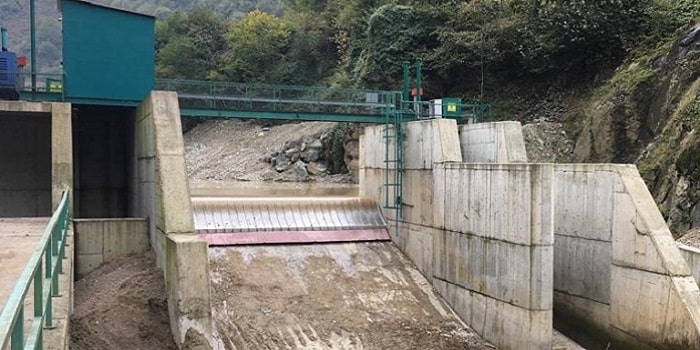
ADENCO-45
Hatchery raceway intakes and small fish-protection diversions: 5 to 35 l/s per unit, at 35 l/s per metre of screen width. Up to twelve units side by side reach 420 l/s.
Aquaculture and fish-protection intakes have to be both protective (keeping juvenile fish out of pump bays and turbine galleries) and reliable, because a hatchery that loses its water supply loses a year of fish. Coanda screens exclude juveniles by slot size, carry them over the screen face with the bypass flow instead of holding them against it, and clean themselves while water flows over them, without an operator on site.
The standard 1 mm slot opening excludes young fish (fry and fingerlings) by size. Flow passes across the screen face rather than being pulled through a submerged panel, so fish travel over the surface with the bypass flow: the fish are not pressed against the screen, and there is no pumping or suction at the screen face. The slot opening and the fish-protection criteria are documented with every delivery.
The standard 1 mm slot opening prevents young fish (fry and fingerlings) from being drawn into the intake, and narrower openings are available where a hatchery or a permit requires them. This matters for hatchery raceway intakes, and for protecting fish that move downstream on rivers where fish screens are required by law.
A rotating screen that clogs during a heatwave can kill a hatchery's entire fish stock. A Coanda screen is passive: the screen cleans itself while water flows over it, without bearings, chains, or seals that fail at the worst time.
304 stainless steel as standard for fresh water, 316 or 316L where the chemistry is more corrosive, Duplex 2205 for brackish water, Super Duplex 2507 for high-chloride coastal hatcheries. A material recommendation confirmed by an engineer comes with every project.
Hatchery raceway intakes and small fish-protection diversions: 5 to 35 l/s per unit, at 35 l/s per metre of screen width. Up to twelve units side by side reach 420 l/s.
Intakes for fish farms and for diversions where a fish screen is required by law: 25 to 100 l/s per unit, at 67 l/s per metre of screen width. Up to eight units side by side reach 800 l/s for larger raceway systems.
Screens for this application are among the 500+ ADENCO projects delivered in 20+ countries since 2013. Reference projects for this application are available on request.
Enter your flow rate, type of water body, and site geometry. Get a preliminary configuration in minutes. No contact details required to see the result.