ADENCO-45
Diversions for smallholder cooperatives and on-farm intakes: 5 to 35 l/s per unit, at 35 l/s per metre of screen width. Up to twelve units side by side reach 420 l/s.
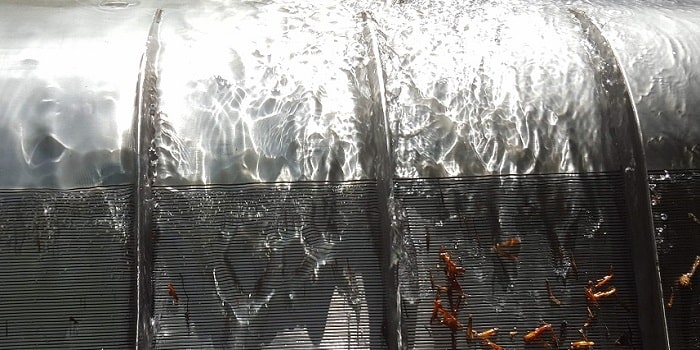
Agricultural diversions have two problems: silt carried by storm flows, which clogs drip emitters and bar screens, and operator labour that grows in step with the amount of debris. Coanda screens clean themselves while water flows over them: the flow across the screen face, at 1.8 to 3.7 m/s, carries silt and organic debris off the screen, so the irrigation channel keeps flowing free of debris without a maintenance crew.
The standard 1 mm slot opening rejects the sand, leaf matter, and strands of algae that clog drip emitters and pivot nozzles, and narrower openings are available where the irrigation system needs them. One screen at the diversion replaces dozens of inline filters downstream.
Bar screens and trash racks need clearing exactly when nobody wants to be standing in the canal: during high flows after a storm. On a Coanda screen the flow across the screen face carries debris off by itself, with no operator intervention required.
Off-grid diversions and remote canal headworks have no electricity supply for rotating screens. A Coanda screen is gravity-fed by design, so the same diversion drop that delivers water to the canal also powers the self-cleaning action.
The 1 mm slot opening keeps young fish (fry and fingerlings) out by size, and flow passes across the screen face rather than being pulled through it, so fish are carried over the surface with the bypass flow instead of being held against the screen. Important where irrigation diversions are located on rivers shared with fishery interests.
Diversions for smallholder cooperatives and on-farm intakes: 5 to 35 l/s per unit, at 35 l/s per metre of screen width. Up to twelve units side by side reach 420 l/s.
Canal headworks and intakes for irrigation associations: 25 to 100 l/s per unit, at 67 l/s per metre of screen width. Up to eight units side by side reach 800 l/s for diversions that serve an entire irrigation area.
A complete, ready-to-install Coanda screen unit in an enclosed housing with an integrated outlet, 5 to 100 l/s. Bolted assembly, fast to install on a farm or cooperative diversion, relocatable to another site later, and it avoids heavy investment in concrete works.
Five clips from agricultural diversions: approach flow, the sheet of water crossing the screen face, and debris carried past instead of collecting on a rake.
Enter your flow rate, type of water body, and site geometry. Get a preliminary configuration in minutes. No contact details required to see the result.