ADENCO-45
Rural and small municipal intakes: 5 to 35 l/s per unit, at 35 l/s per metre of screen width. Up to twelve units side by side reach 420 l/s.
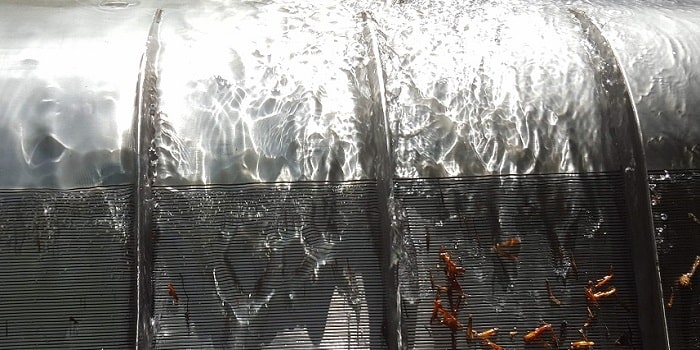
A drinking-water intake has one job: deliver raw water to the treatment plant continuously, without an operator on site. Coanda screens do this passively. No moving parts, no electricity at the intake, a standard 1 mm slot opening (narrower where needed), and fish protection built into the design.
No motors, no moving parts, no electricity at the intake. The water flowing over the screen keeps it free of debris, so cleaning is reduced from a daily task to a short check a few times a year, and the water supply to the treatment plant is never interrupted for it.
The 1 mm slot opening holds back leaves, gravel and coarse sand: the material that wears out pump impellers and blocks pipes. Fine silt still passes through to the treatment plant, which is built to cope with it. The screen's job is to protect the plant, not replace it.
Water flows across the screen surface, and the slots draw off part of that flow as it passes, so there is no suction pulling fish against the surface. Young fish are carried over the screen with the remaining flow and returned to the river. The slot opening and fish-protection performance are documented with every delivery; site-specific permit requirements are reviewed project by project.
304 stainless steel is the standard grade for fresh water, 316 and 316L for more corrosive water, and duplex grades for brackish or saline water. An engineer-reviewed material recommendation is included with every delivery.
ISO 9001 and ISO 10002 certificates, EN 10204 3.1 material certificates, a project Inspection and Test Plan covering factory and site acceptance test (FAT/SAT) procedures, and notes on conformity with the EU Water Framework Directive and IHA guidance. A calculation and conformity document is available on request. All of these are included with the order; nothing has to be ordered separately.
Rural and small municipal intakes: 5 to 35 l/s per unit, at 35 l/s per metre of screen width. Up to twelve units side by side reach 420 l/s.
Mid-size municipal water withdrawal: 25 to 100 l/s per unit, at 67 l/s per metre of screen width. Up to eight units side by side reach 800 l/s where the demand of a supply district exceeds the capacity of one unit.
Large city intakes: 150 l/s per metre of screen width. An array of several units reaches 6,500 l/s for large municipal water projects.
A complete, ready-to-install Coanda screen unit in an enclosed housing with an integrated outlet, 5 to 100 l/s. Bolted assembly, fast to install, relocatable to another site later, and it avoids heavy investment in concrete works.
Three clips: water entering the screen at a village intake in Trabzon, the same kind of intake with its outlet valve closed and then opened, and an intake operating through cold weather where continuous flow across the screen face is what keeps the screen free of ice.
Enter your flow rate, type of water body, and site geometry. Get a preliminary configuration in minutes. No contact details required to see the result.