ADENCO-45
Micro-hydro and small mountain-stream intakes: 5 to 35 l/s per unit, at 35 l/s per metre of screen width. Up to twelve units side by side reach 420 l/s. The smallest width proven in operation is 150 mm.
A blocked hydropower intake means a hydropower plant that generates nothing, and mountain streams deliver leaves, branches, gravel and flood debris exactly when the flow, and the power output, is highest. A Coanda screen carries that load across the screen face under gravity and off the downstream end, so the plant keeps operating during heavy rain and the turbine receives water that contains no particle larger than the slot opening. It is self-cleaning in operation; at most sites the screen is brushed clean by hand when the seasons change.
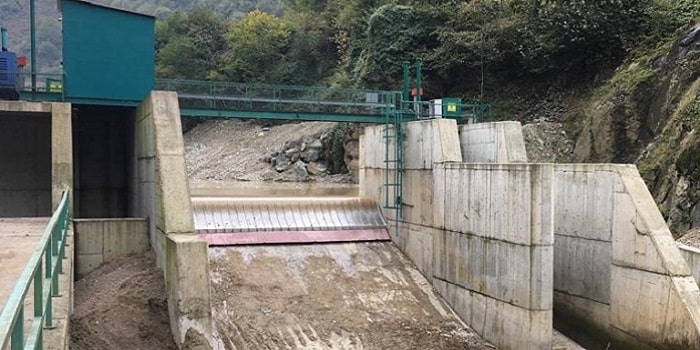
Tyrolean trash racks and bar screens block when the river rises, which is exactly when a run-of-river hydropower plant earns most of its revenue. The usual solution is to open the flushing gate and stop the turbine until the flood water has passed. At Seydioğlu HPP (hydropower plant) in Trabzon the original trash rack forced that shutdown every flood season; since the 2019 Coanda retrofit the 2,500 l/s intake has kept the plant generating at full output through the same floods. Water above the design flow passes over the screen and stays in the river, which is what your environmental-flow permit requires in any case.
Seydioğlu HPP: the Tyrolean-to-Coanda retrofitThe standard 1 mm slot keeps gravel, coarse sand, leaves and branches out of the penstock, so nozzles, runners and guide vanes suffer far less abrasion and impact damage between overhauls. Slots from 0.5 to 2.0 mm (1.0 mm standard) are available and can be matched to the turbine type; narrower slots can be produced on request. A narrower slot means more screens for the same flow, so we quote the budget effect alongside it. Silt smaller than the slot opening still passes, and we state clearly at the sizing stage whether a sand trap is still needed. At Kigasa in Rwanda the forebay is located directly below the screen, with no separate settling basin, and the full 80 m of hydraulic head reaches the Pelton turbine.
Slot guidance by turbine typeFlow passes across the screen face, not through a submerged panel, so fish are carried over the surface into the water below the weir instead of being held against the wedge wire. The 1 mm slot is one third of the 3 mm screen opening that UK regulators name as the default for Pelton and Turgo intakes, and far narrower than the 10 to 20 mm bar spacing written into Alpine fish-protection rules. We supply the intake drawings and a technical note for your permit file.
The existing weir is usually kept. Some changes to the existing concrete are normally needed, and the screen is mounted in the structure or on a fabricated steel frame. Because the opening already exists, or its dimensions are already set by an approved structural design, we build the screens to those dimensions; we do not ask you to change the concrete to suit the screens. Weir width and the available drop decide whether a retrofit is feasible. Send us a cross-section drawing of your weir and we confirm both before fabrication starts.
Read the Tyrolean retrofit guideOn rivers that carry heavy debris, an upstream set of protection bars (stainless steel bars mounted in front of the wedge wire) takes the impact of logs, branches and rolling stones before they reach the wedge wire, as was done at Kigasa. The bars also carry part of the flow: water clings to the bar surface and runs down over it without reaching the wedge wire, so a screen behind protection bars loses roughly 10-15% of its capacity depending on the design and screen type. A screen behind protection bars is sized with that allowance, not from the catalogue capacity alone.
Water moving across the screen face is what keeps the screen free of ice in freezing weather. ADENCO mountain intakes in Türkiye operate under snow and ice cover, with the screen still taking water beneath the ice, and the screen face becomes free of ice again once flow and temperature return.
Two Trabzon intakes photographed under iceHydropower intakes go into operation after a local water-authority approval, and we prepare the intake documentation that approval file needs: design report, hydraulic sizing and drawings. For Gongele HPP, 28 screens and 4,424 l/s, the complete set of documents was approved as submitted. Every delivery ships with ISO 9001 and ISO 10002 certificates, EN 10204 3.1 material certificates and an inspection and test plan with factory and site acceptance tests (FAT/SAT). Drawings in 2 business days; 2 to 4 weeks ex-works for standard orders, up to 8 weeks for high-capacity hydropower arrays of more than ten units.
Gongele HPP: 28 screens, approved as submittedMicro-hydro and small mountain-stream intakes: 5 to 35 l/s per unit, at 35 l/s per metre of screen width. Up to twelve units side by side reach 420 l/s. The smallest width proven in operation is 150 mm.
Small hydropower and mountain intakes: 25 to 100 l/s per unit, at 67 l/s per metre of screen width. Up to eight units side by side reach 800 l/s. The most common ADENCO hydropower unit.
High-capacity intakes: 150 l/s per metre of screen width, with multi-unit arrays serving hydropower plants of up to 6,500 l/s. Gongele HPP uses 28 screens for 4,424 l/s.
Built to the dimensions your site already sets: the opening of an existing weir in a retrofit, or the concrete of an approved structural design. Non-standard widths, heavier construction for rivers that carry boulders, and flows above the standard arrays. Four of the seven hydropower intakes shown on this site are custom builds, including Seydioğlu HPP at 2,500 l/s.
Five clips: the Seydioğlu retrofit followed from the workshop to water flowing in a thin sheet over the rebuilt weir, an intake inspected right after a flood with the wedge wire intact under its protection bars, flow above the design flow passing over a screen, an intake operating through snow, and heavily silted floodwater crossing the screen face.
Enter your flow rate, type of water body, and site geometry. Get a preliminary configuration in minutes. No contact details required to see the result.
Retrofitting a Tyrolean intake? Send us a cross-section drawing of your weir.